
In many companies, the same thing happens every Monday. The project manager opens three different tools, copies data into a PowerPoint, writes a brief comment, and sends the result to management. This takes two hours. And next week it all starts over.
The actual problem is not the effort. It is the fact that this report always arrives too late, is never complete, and depends on the quality of manual work.
Yet all the information has long been available. It just lives in different systems and nobody brings it together automatically.
The idea is simple: project data typically lives in multiple sources at the same time. Tasks and progress in a project management tool, costs in a spreadsheet, risks in another document. No single system has the complete picture.

This is exactly where this workflow comes in. It automatically pulls data from all three sources, processes it with AI, and generates a structured status report directly in Confluence — without any manual intervention.
Four core building blocks were combined for the implementation:
A project management tool for tasks and progress, a database for the cost overview, a spreadsheet for the risk register, and a wiki system for the automatic report output.
The specific tools used were:
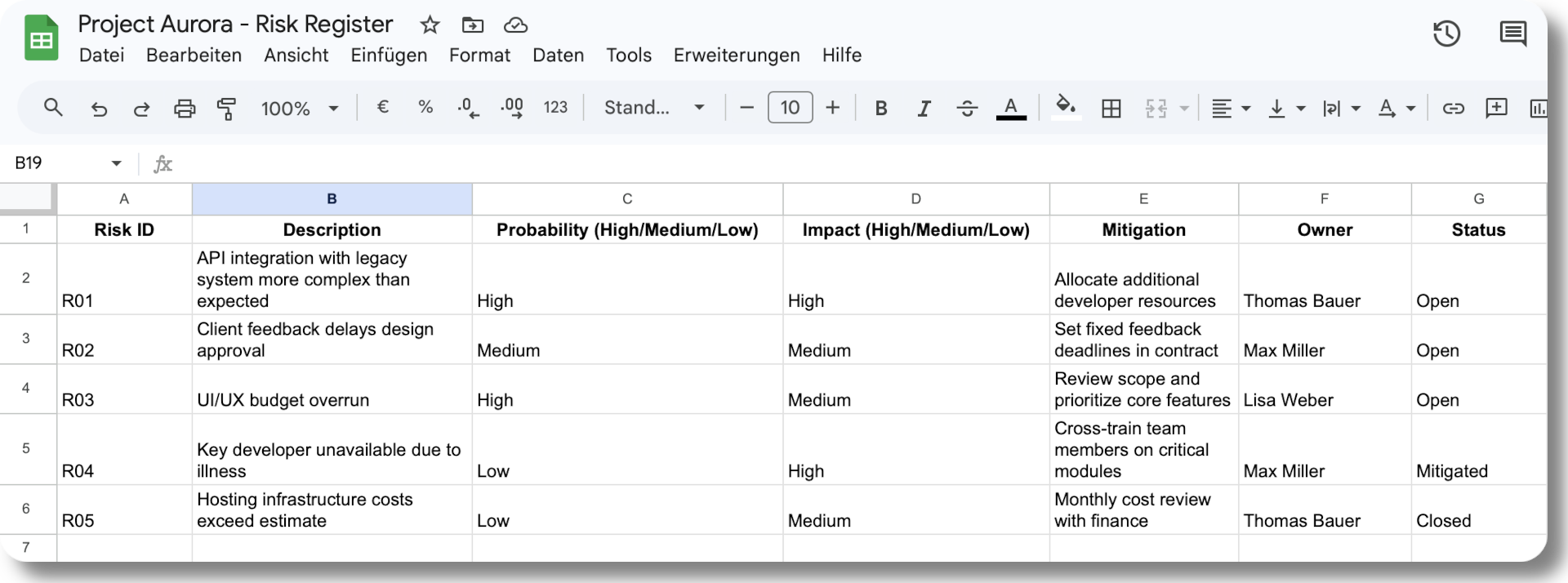
Jira for tasks, epics, status, and deadlines, NocoDB for project costs by category, Google Sheets for the risk register, and Confluence as the output for the finished report.
The entire orchestration runs via n8n, and an AI model handles the analysis and preparation of the content.
The workflow starts automatically on a defined schedule — daily or weekly, depending on the need.
In the first step, all three data sources are queried in parallel. From Jira: all tasks with status, owners, and deadlines. From NocoDB: the current cost overview by category. From Google Sheets: the risk register with probability, impact, and countermeasures.

All data is consolidated in n8n and passed together to an AI agent. The agent analyzes the information, calculates key metrics such as budget consumption or overdue tasks, assesses the overall status, and formulates concrete recommendations for management.
The result is output as a structured HTML report and automatically created as a new page in Confluence.
The workflow was fully mapped in n8n. Each data source has its own node that retrieves the data and reduces it to the relevant fields. An aggregation node combines all data into a single structured input before it is passed to the AI agent.

The AI agent works with a clearly defined prompt that ensures the output always follows the same structure. The result is a report that is directly readable without any post-processing.
A new wiki page is automatically created via the Confluence REST API and populated with the generated report.
The finished status report for management includes an executive summary with a traffic light status, a task overview grouped by epics with overdue tasks highlighted, a budget overview with total consumption and risk flags, a risk overview with critical risks highlighted, and the three most important recommendations for management.

The actual problem in projects is rarely missing knowledge. It is missing availability and missing structure.
The data is there. It is just distributed, outdated, or hard to access. A decision-maker who wants to know the current project status today still has to ask around. With this workflow, the report is simply there — automatic, structured, and always current.
The automation delivers several direct benefits. Manual report creation is eliminated entirely. The report is always current and based on real data. Management has a clear overview at all times without having to ask. And the team can focus on the actual project work instead of reporting.
With a combination of three data sources, an automated workflow, and AI-powered analysis, a status report that used to take hours is generated fully automatically in a matter of minutes.
The decisive factor is not the technology itself, but the way it is used. When data is automatically consolidated and prepared, transparency emerges without effort.
Project data exists in every company. The question is not whether it exists. The question is whether it can be used to make well-founded decisions.
This example shows how distributed raw data becomes a clear, structured CEO report — fully automated and without any manual work.